
The noted economist Thomas Sowell once said that there are no solutions, only tradeoffs. This is also true for our concealed carry pistol. There is no one “perfect pistol” for our needs. Every pistol out there is a compromise between three board ranges of features: Concealability, accuracy and firepower.
Concealability is a measure of how easy it is to carry any given pistol in a discreet manner and is made up of a balance between height (the distance from the top of the slide to the bottom of the magazine), weight and thickness. The portion of the gun which “prints” or noticeably protrudes from our clothing is almost always the grip of the pistol. Therefore, pistols with smaller, shorter grips tend to be easier to conceal. Lighter pistols also tend to be easier to conceal, as they have less tendency to sag outwards and reveal themselves to the world. Finally, thinner pistols protrude less, and are therefore easier to keep hidden until needed.
Accuracy is based on a number of things. Heavier pistols handle recoil better than lighter pistols do. The action inside a 1911 tends to be more accurate than that of a striker-fired polymer gun. A larger grip means you have more to hold onto during aiming and under recoil. Finally, firepower is the hardest to pin down, but think of it as a combination of cartridge power and magazine capacity. Think of “firepower” as the total amount of hurt you can throw at a bad guy without having to reload, and you get the idea.
There are some times when one attribute outweighs the others. For instance, when I know that discretion is going to trump all other concerns, I’ll slip a .22LR Ruger LiteRack into a pocket holster and carry that around. Is it the ultimate manstopper? No, but I can have it with me in places where a bigger gun might attract undue attention.
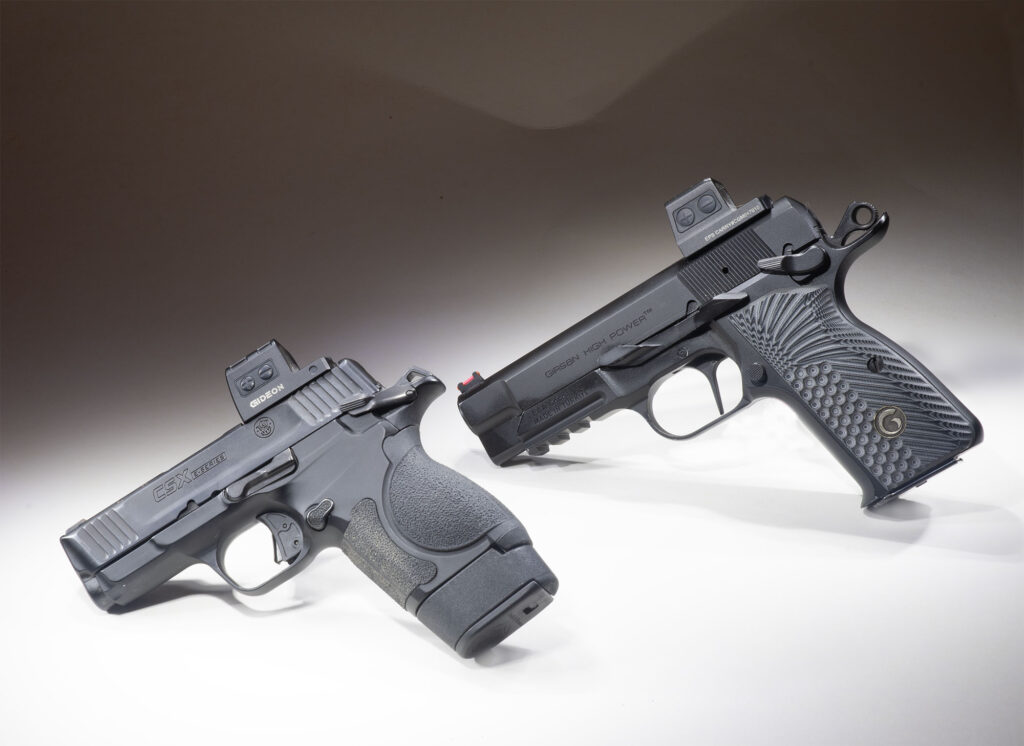
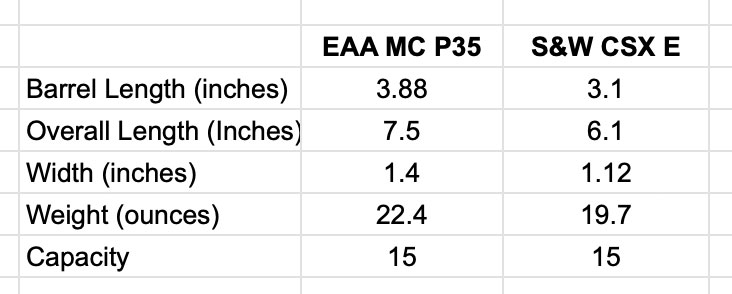
Just how much of a penalty in firepower and accuracy do I incur if I choose a smaller, more concealable gun? In order to answer this question, I’m going to take two similar pistols of different sizes to the range and conduct a series of tests. I’ll be shooting two single-action, hammer-fired double stack 9mm pistols, namely an EAA/Girsan MC P35 PI Ops, a compact clone of the iconic Browning HiPower, and a Smith & Wesson CSX E-Series with a 3.1 inch barrel. I’ll use these guns in three drills and compare the results.
Drill Number One: Bakersfield PD Pistol Qualification
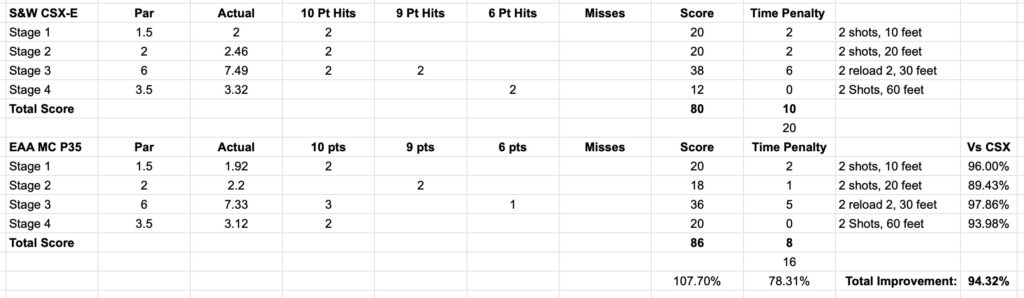
This is my standard “cold” drill for any given range session, The old Bakersfield PD Pistol Qual covers a variety of target sizes and has a reload, so it’s a good “all in one” judge of your skill (or lack thereof) with a pistol
Wow, do those times suck. I am usually in the low 90’s on this drill, so 80 points is downright embarrassing. Kids, eat your vegetables, say your prayers and do your dry fire practice every night, or else you’ll wind up with scores like what you see here. However, I did pass. Yay me.
The numbers show that not only did I shoot faster with the larger gun, (over twenty percent faster), I was more accurate as well, but at a slightly lower percentage. This is due, I believe, to having red dot sights on both guns, which negated the longer sight radius of the EAA HiPower when it came time to make 10 yard and 20 yard shots.
Drill Number Two: Old West Playing Card Drill
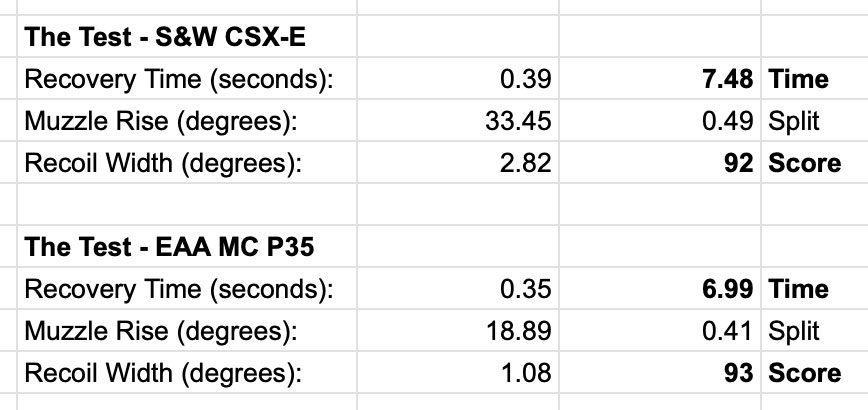
Now let’s kick things up a notch, and add a Mantis X10 Elite to the bottom of each gun. This will allow us to get hard numbers on how recoil affects each gun. We’ll start out with another classic drill, the 5 Yard Playing Card Drill, shot from low ready.
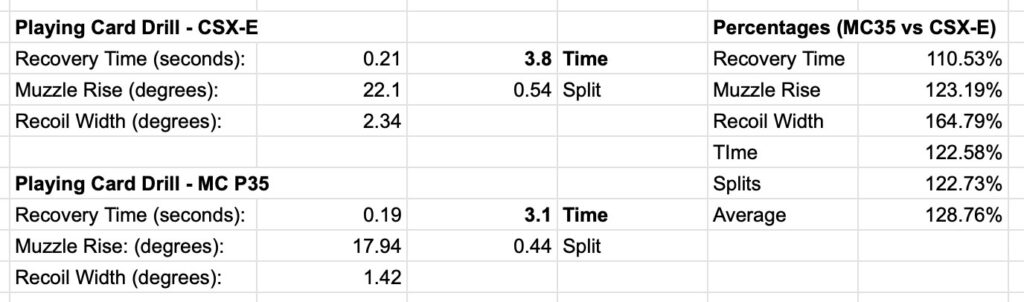
Once again, the larger EAA pistol was faster. I didn’t record the accuracy scores, as this is a pass/fail sort of drill, but I had all my shots with both guns inside of the card. The numbers are interesting: Let’s break them down in more detail.
- Recovery Time: This is the time it took for the sights to get back on target, as measured by the Mantis X
- Muzzle Rise: How much the muzzle rose in degrees, as measured by the Mantis X
- Recoil Width: How much the pistol moves sideways under recoil, measured in degrees
- Recoil Height: How much the pistol moves up and down during recoil, measured in degrees
- Split Time: The average time in-between each shot
What’s interesting in these stats is how much more the smaller CSX moved to the left and right during recoil. I attribute this to the smaller grip on this pistol, which is a perfectly fine size for a micro-compact 9mm. However, the grip on the HiPower is absolutely fantastic, and I think that made the difference here.
Drill Number Three: The Test
You know it, you love it, let’s shoot it once again. The interesting thing I see in the numbers for this drill is the difference between the amount of muzzle rise and my split times. One would think that almost two times the muzzle rise with a smaller gun would result in significantly longer split times, but that’s not the case. This tells me that my recoil control skills are working overtime to correct the muzzle flip that was occurring, making carrying that little CSX-E even more viable.
The Pros and Cons of a Smaller Gun
Totaling everything up, for someone like me, a “C” Class USPSA shooter who is on the center-right of John Hearne’s Automaticity chart, using a small gun means about a 20 percent hit in performance versus a larger gun. What do I gain?
Well, over the years, I’ve carried a variety of guns, everything from an O.G. S&W Shield to a Glock G19 to a 9mm 1911. I’m used to carrying a bigger gun, but do I want to?
If I go off of the numbers, 81.9 percent of the time, all I need is a gun, any gun, so I have that covered. I can make my hits (albeit a bit slower) with the smaller gun, a gun that is significantly easier to carry and easier to conceal. Do I make a compromise when I choose that pistol over it’s larger cousin? Sure. But let’s be honest, if I knew for certain I’d be getting into a defensive encounter this afternoon, I wouldn’t carry either gun, I’d have an AR-15 and a squad of Marines with me. All defensive pistols are a compromise. All of them. Hopefully now, you’ll have an idea of just how much of a compromise you’re making if you choose to carry a smaller gun.
For dealer purchases visit www.davidsonsinc.com
For consumer purchases visit www.galleryofguns.com