
A few months ago, I was invited to a hunt in eastern Wyoming sponsored by Hornady Ammunition and Savage firearms, and the gun I used on this adventure was a little different. Rather than shoot a full-sized rifle in the latest and greatest wonder cartridge, I shot with a Savage 110 PCS bolt-action pistol chambered in .308 Winchester.
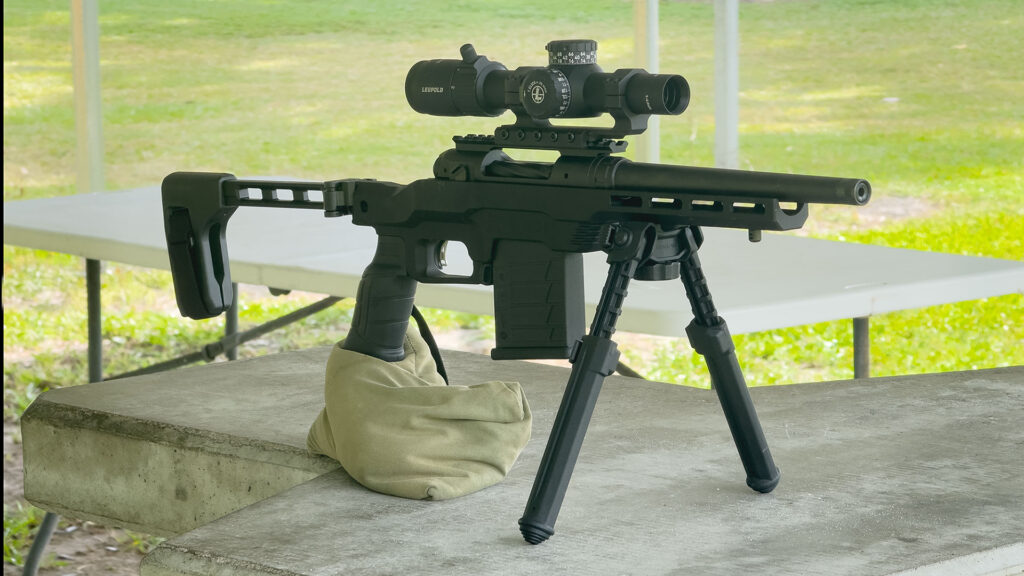
The cartridge may have been “plain Jane,” but the gun certainly was not. I am no stranger to rifle-caliber pistols, having owned a variety of AR-15 with stabilizing braces for years now. This, however, was my first outing with a bolt-action rifle-caliber pistol.
One thing that stood out on this four-day hunt was just how convenient the Savage 110 PCS was to carry around. Walking to and from the shooting locations each day was a breeze, and the professional hunter who was guiding me on the hunt mentioned how easy the pistol would be to carry around in a backpack.
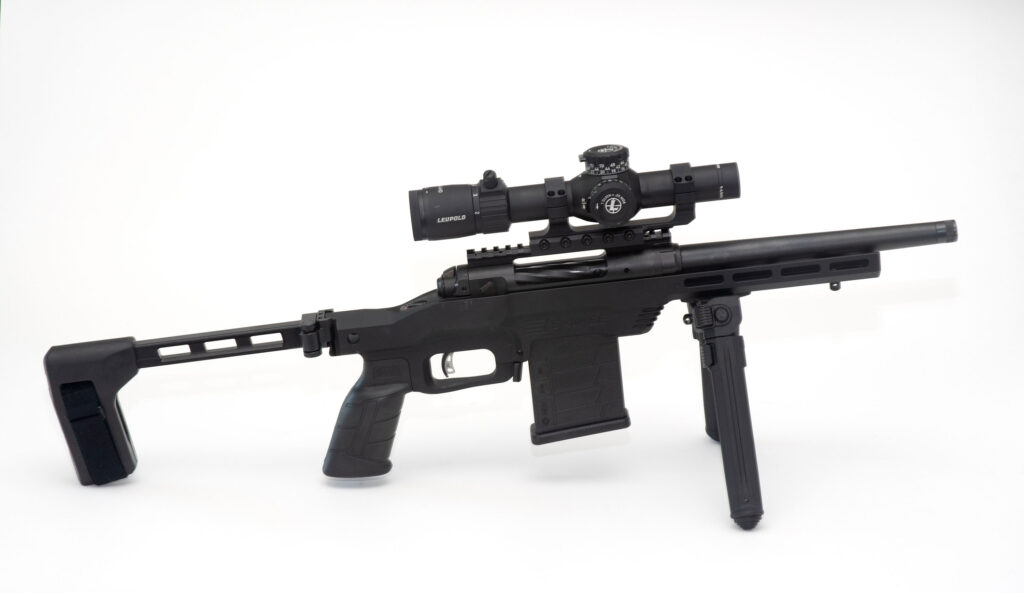
Savage 11o PCS Side Angle View
Which got me thinking about Col. Jeff Cooper’s “scout rifle” concept. This idea from the early 1980’s is intriguing, as it is, in essence, the rifle to have if you could have only one. A Scout Rifle should be easy to carry, easy to shoot, capable of making first-round hits on targets from three to three hundred yards and have enough power to take on just about any North American game animal.
It took awhile to catch on inside the firearms community, but now we see scout rifles (or rifles being marketed as scout rifles) being offered by practically everyone who makes a bolt-action rifle, including Savage themselves.
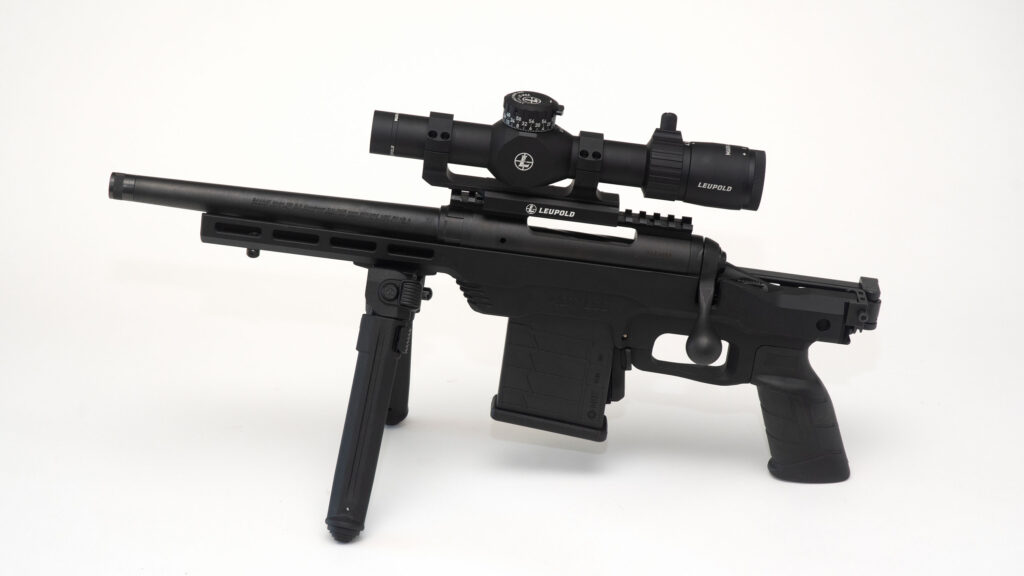
The folding stock makes the 110 PCS an easy firearm to transport
Things are changing, though, and the recent alterations to the National FIrearms Act (NFA) mean it’s going to become even easier to own a Short-Barreled Rifle (or SBR) and pistol-sized firearms in rifle calibers are going to be more and more popular.
Put these two together and you have an idea that I like to call the Scout Pistol. It has all the parameters of a Scout Rifle (low weight, adequate firepower, quick engagement time) in an even smaller package.
I had already decided to use the Savage 110 PCS for this project, but I am a little different. I am cross-eye dominant: I am right-handed, but my left eye is my preferred eye for seeing. Because of this, I’ve shot rifles from my left shoulder for years now, so the left-handed bolt on the Savage 110 PCS is no problem for me. Your mileage may vary.
Next came choosing a round to use. Tradition says I continue on with the .308 Winchester round, and that is a tempting choice indeed. I have shot thousands and thousands of rounds of .308 Winchester and know what it can and cannot do. However, after extensive discussions with representatives of both Hornady and Savage, I have chosen 6.5 Creedmoor for this pistol. Cue the dramatic gasps of horror and amazement.
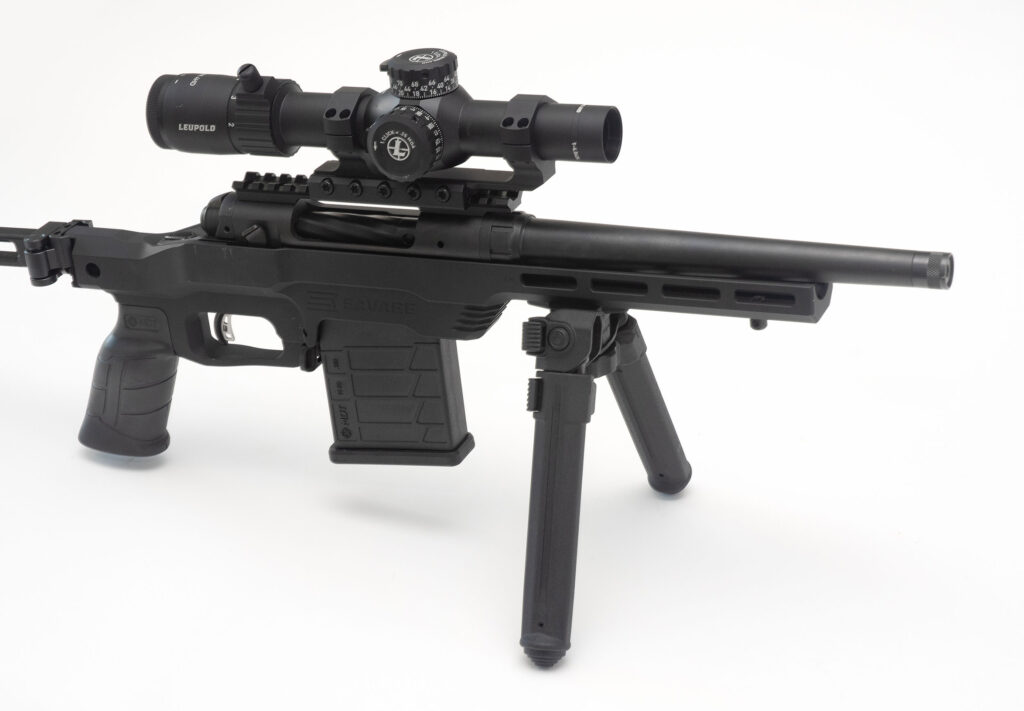
Shown with a Leupold Mark 4HD 1-4.5x scope with a HPR-1 reticle
At first glance, using 6.5 Creedmoor in a gun with a 10.5 inch barrel seems a little silly. 6.5 Creedmoor is all about long-distance accuracy, why use it in a gun that’s designed to top out at 300 yards? The reason is found in that previous sentence: Accuracy. Based on everything I’ve found, 6.5 Creedmoor is a more accurate cartridge than .308 Winchester at every distance. Add in the fact that 6.5 Creedmoor has more velocity (and therefore more energy) at almost every barrel length compared to .308 Winchester, and it starts to make more sense.
The original Scout Rifle used a forward-mounted fixed 4X handgun scope to (in theory) provide a fast aiming point for close-range shots and some magnification for when a longer distance shot was necessary. It worked, but since then, the Low Power Variable Optic, or LPVO. These offer you a low-power view for when things are up close and personal and with the spin of a dial can reach out to 4x, 6x or even 10x magnification. As I was looking to keep things at 300 yards or less, I went with a Leupold Mark 4HD 1-4.5x scope with a HPR-1 reticle. Because it’s a second-focal plane optic, the reticle doesn’t change size as I zoom in and out, and the lack of complex reticle markings makes fast, high-stress shots easier to accomplish.
One drawback to an LPVO is all the glass inside of them makes them heavier than a fixed-magnification optic, but at just 18 ounces, the Mark 4HD LPVO is on the lighter side of this market niche.
The final piece of the Scout Pistol puzzle was a stabilizing brace to add to the short section of Picatinny rail at the end of the pistol. The ATF has gone back and forth on whether or not American gun owners can legally place a brace up against your shoulder to not. It appears that issue has been settled, however, so I went to SB Tactical, the originator of the pistol brace, for a rugged FS1913 brace to add to this gun. To add even more stability to the pistol, I attached a Magpul MOE QD bipod into the M-Lok slots on the stock and left room for shooting off-hand or an Arca-Swiss plate in case I wanted to shoot from a tripod.
Having finalized the gun and accessories, it was time to go to the range. I’ll state my biases up front: I like Savage rifles. I own three, and I’ve found them to be excellent value for the money. The trigger on mine pistol broke at 2.6 pounds from the factory and is easily adjustable thanks to Savage’s Accutrigger system. The pistol uses standard AR-15 grips and AICS-pattern magazines, and the 10-5 inch barrel is threaded if you wanted to add a muzzle device or a suppressor.
Savage bolt-action firearms are known for being friendly to lefties, and the 110 PCS is no exception. The safety is located on the back of the tang, easily reachable by either hand, and the magazine release is ambidextrous as well.
A defining characteristic of the Scout Rifle concept is light weight, ideally at 6.6 pounds / 3 kilograms with an optic. The metal chassis, metal stabilizing brace and LPVO on this pistol means I’m 1.2 pounds over that limit, however, the small size means it’s very easy to carry around.
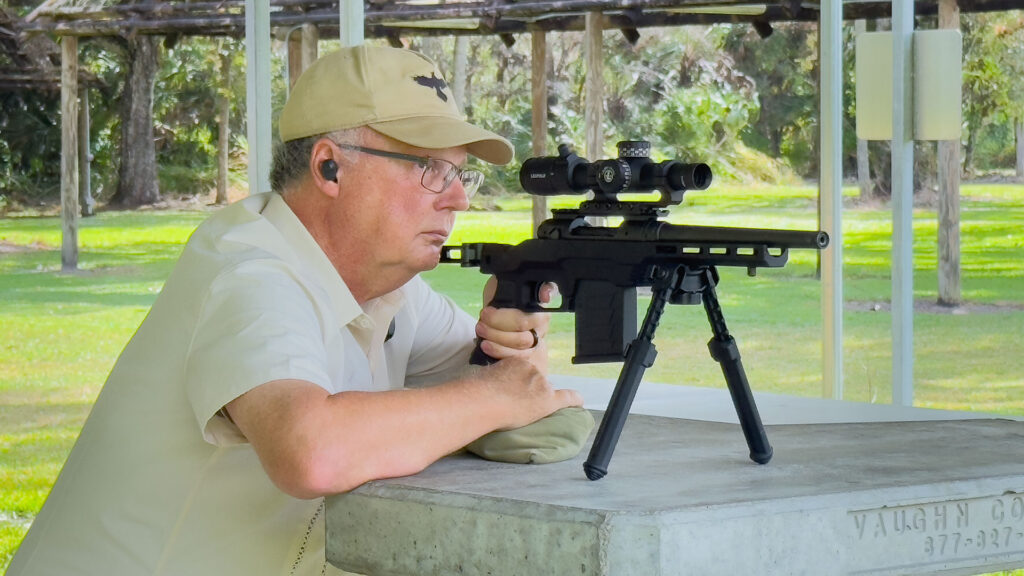
Author Testing the Savage 110 PCS
Working from a bipod off a bench and using a rear sandbag for stabilization, I managed to shoot a sub-MOA group with this pistol using Federal 140 grain Fusion Tipped rounds, with the 143 grain Hornady ELD-X round performing just below that. Both brands of ammunition shot under 2 MOA, though, which is the standard that Col. Cooper set for a scout rifle.
Is the “Scout Pistol” a replacement for the scout rifle? Probably not. Does the smaller overall length and folding brace make it easier to manage and carry with you in the field? Absolutely yes. If you’ve been looking for a firearm to have with you to cover a variety of situations, something like the Savage 110 PCS or a similar short-barreled rifle might be just what you need.
Savage 110 PCS Specifications
Caliber: 6.5 Creedmoor
Front Sight: N/A
Rear Sight: N/A
Frame size: Pistol
Barrel Length: 10.5 inches
Overall Length w/ Brace (Closed): 21 inches
Overall Length w/ Brace (Open): 30 inches
Weight (unloaded, without brace or optic): 5.63 pounds
Barrel Threads: 5/8×24
Magazine Capacity: 10 rounds
Magazines Included: 1
MSRP: $606.99
100 yard Bench Rest Accuracy Results
140 Federal Fusion Tipped, five 5 shot groups
Average group: 1.3 inches
Minimum group: 0.98 inches
Maximum group: 1.63 inches
Average velocity: 2026 fps
143 Grain Hornady ELD-X, five 5 shot groups
Average Group: 1.57 inches
Minimum group: 1.29 inches
Maximum group: 1.8 inches
Average velocity: 2136 fps
For Dealer Purchases visit www.davidsonsinc.com
For Consumer Purchases visit www.galleryofguns.com