
More than fifty years ago, West German police conducted a competition for a new service pistol in the war on terror. The result was the SIG P220, which evolved into the P226, P229, and others. SIG won the contest based on quality of manufacture, reliability, and accuracy. A new tactical doctrine of simplicity was born as well. SIG branched out into other types, including .22 rimfires and a modern 1911 handgun. I was excited to obtain one of the first SIG 1911 handguns. They did well, applying modern manufacturing techniques and tolerances to the 1911 platform.
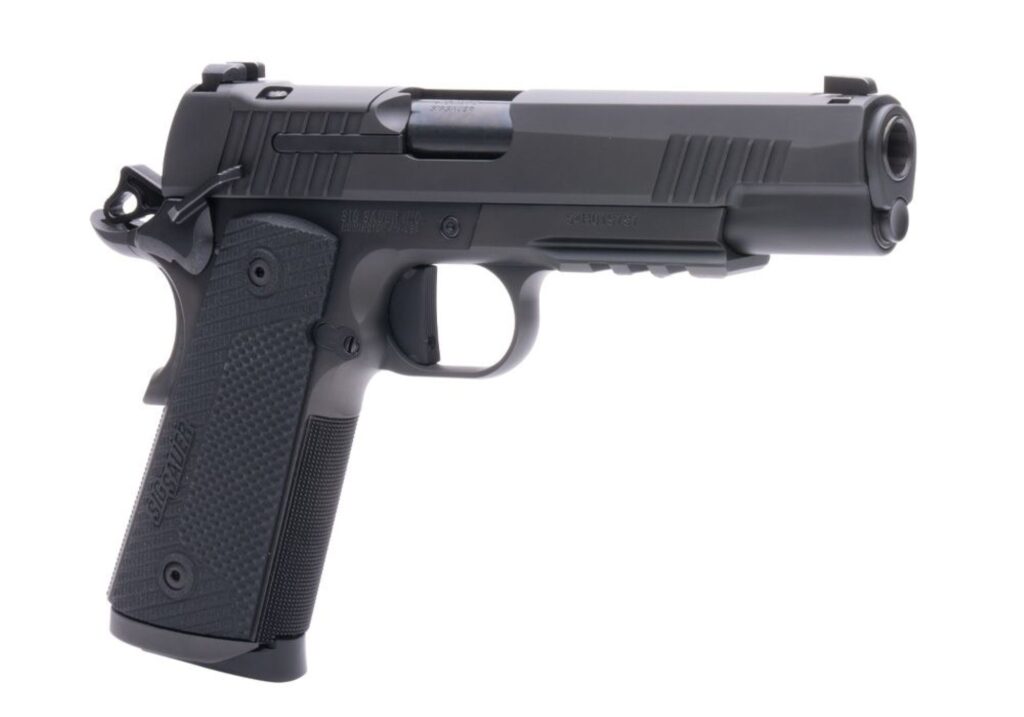
While some makers seek to manufacture a 1911 as cheaply as possible, SIG has given us a 1911 pistol as well-made as possible. Manufacturing an all-steel pistol isn’t inexpensive and requires considerable skill.
The 1911X is a single-action pistol with a positive firing pin block. SIG pioneered a positive firing pin block on the P series. They set a trend for service handguns. The 1911X features an ambidextrous safety, grip safety, light rail on the frame, and a flat trigger. The pistol features G10 grips with a good balance of adhesion and abrasion, a modest magazine well, and a nicely snug but not too tight barrel bushing. SIG’s X-Ray sights feature vials of radioactive tritium, providing 24-hour utility.
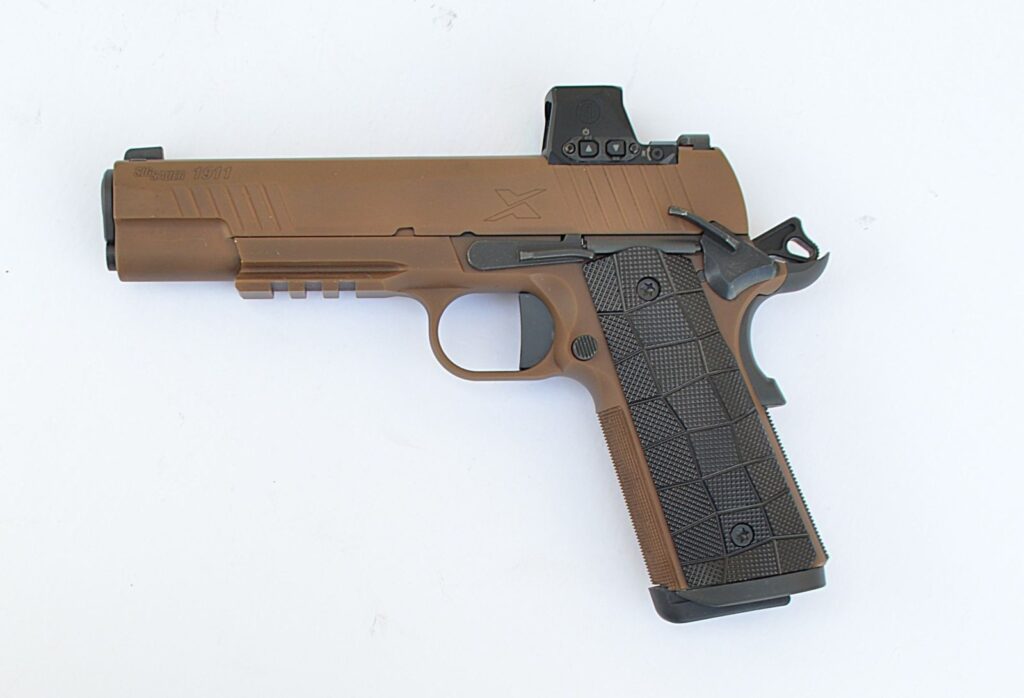
The slide is relatively slim, allowing good concealment with the proper holster. The pistol is heavy—no getting around that—at 42 ounces. This weight makes the pistol controllable with .45 ACP loads. The DLC coating seems rugged, while the metal beneath is stainless steel. The trigger is smooth, with modest take-up and a clean break at 5.5 pounds, measured after the firing test.
Optic and Range Performance
I chose the factory combination of a 1911X in Coyote Tan and a ROMEO-X optic. SIG has done a great job in its Electro-Optics division, with an aspheric lens treated for anti-glare and anti-fog performance. The sight features 15 light settings, including three night-vision settings. The ROMEO-X features automatic shutoff and shake-awake technology. You may change the dot to a dot in a circle by holding the rear push-button control down for three seconds.
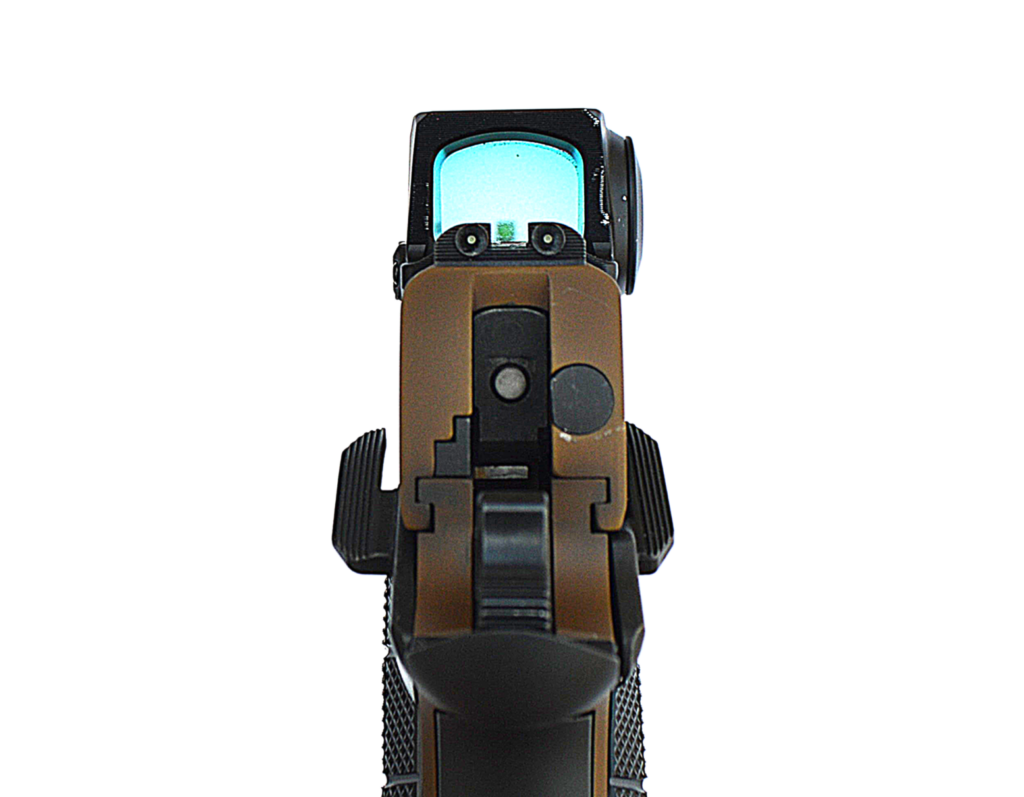
I engaged in a few dry-fire drills, essential with any new handgun to give the piece a fair shake. Satisfied with control of the trigger and having confirmed my ability to quickly engage the red-dot sight, I headed to the firing range. I added a number of Wilson Combat magazines to the two magazines supplied with the SIG because I like to ensure reliable function. Wilson Combat magazines are my favorite 1911 feeding devices. I have enjoyed excellent results with Wilson Combat for many years. Most of the ammunition during the first trip was Federal 230-grain American Eagle. There is nothing more reliable than 230-grain FMJ “hardball” ammunition in a .45 ACP. I also fired a quantity of the similar Federal Syntech loading. Beginning with a well-lubricated pistol, I fired at 7, 10, and 15 yards. The 1911X is pleasant to fire, with modest recoil. The 1911X gets on target quickly.
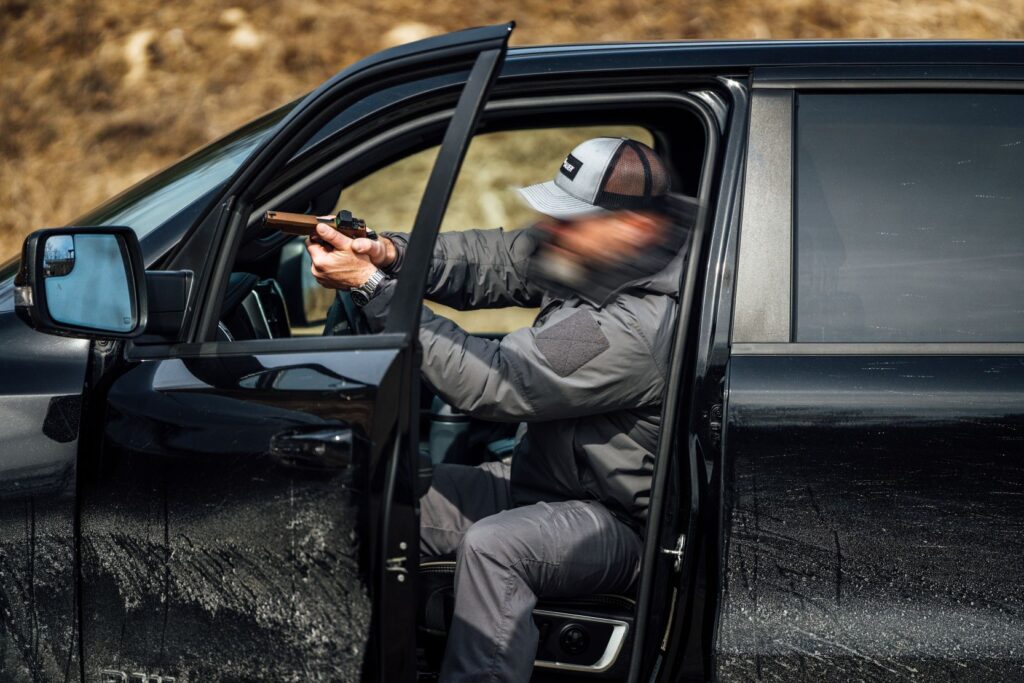
The piece handles well and sends those big .45s into the X-ring on demand in the hands of a trained shooter. No failures to feed, chamber, fire, or eject were experienced on that first day. Good results have followed. The pistol is especially pleasant to fire compared to lighter .45s, and the stability and handling of the 1911X make for good results at longer handgun ranges. I practiced speed drills and the standard response drill, coming away with a great deal of respect for the pistol after the first firing session. In later sessions, I pushed both gun and shooter harder.
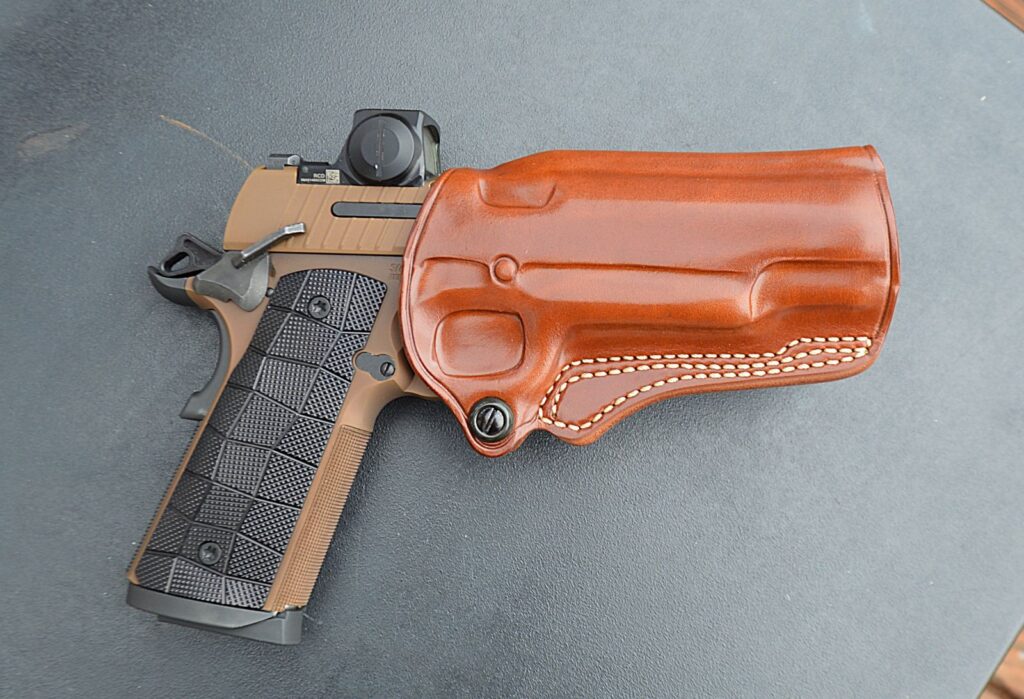
Combat firing results proved that a steel-frame .45 with a superior carry optic is a formidable handgun. Get on target, get a hit, keep your eyes on the target, and place the dot back on the target after each hit. Simple as that. The pistol offers unprecedented hit probability compared to iron-sighted 1911 handguns. The firing experience was pleasant. During the test program, I included several presentations from the Galco Speed Master holster. This is a strong-side OWB holster intended to provide a good balance of speed and security. While ideal for range work, the Speed Master is also well suited to concealed carry if worn behind the hip beneath a covering garment. Other holsters, such as Galco’s extensive line of inside-the-waistband holsters, will offer more concealment. The Speed Master is old-school in fit and finish, with modern performance.
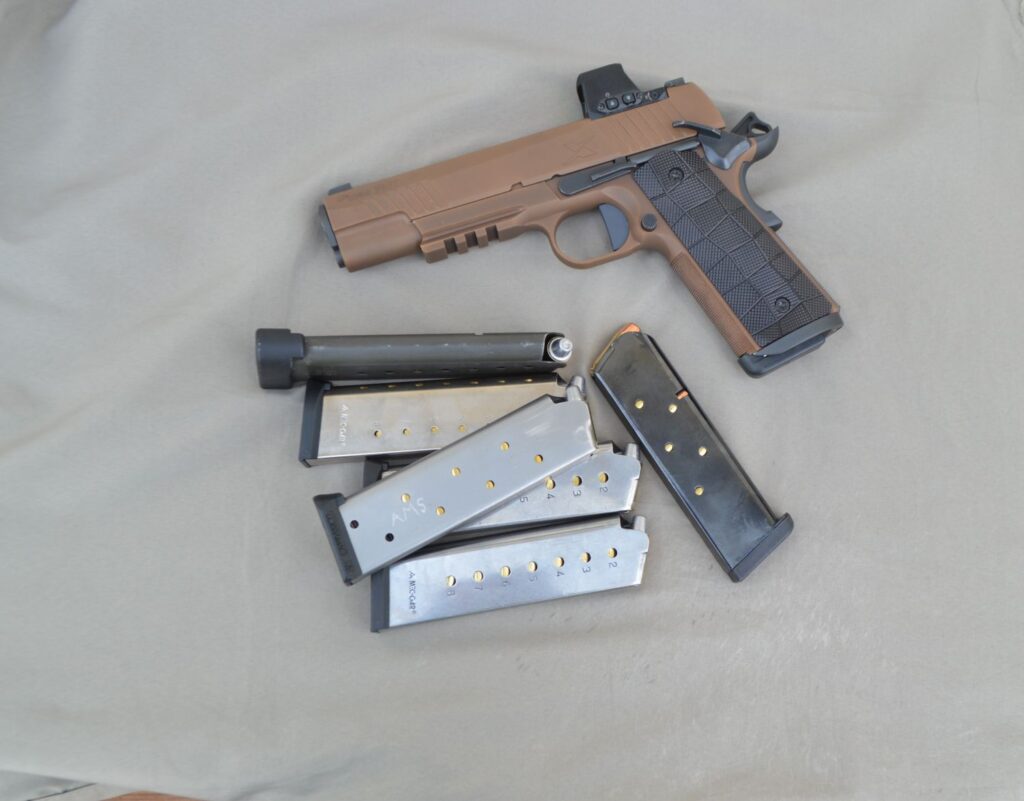
After firing the pistol during several range trips, the final tally showed no failures to feed, chamber, fire, or eject, and good practical accuracy. A clean bill of health, in other words. The final test was a sit-down benchrest accuracy program. I fired a half-dozen .45 ACP loads. Some are practice loads; others have proven accurate in other handguns. In the end, the SIG 1911X provided excellent all-around results. It is well worth its price.
Accuracy Results
Five-shot groups at 25 yards, benchrest
| Load | Group |
| Federal American Eagle 230-grain FMJ | 2.4 inches |
| Federal Syntech 230-grain | 2.6 inches |
| Speer Gold Dot 200-grain +P | 2.0 inches |
| Speer Gold Dot 230-grain | 2.25 inches |
| Federal 230-grain PUNCH | 2.5 inches |
| Federal 230-grain HST | 1.8 inches |
Specifications
| Caliber | .45 ACP |
| Action | Locked-breech, single-action |
| Magazines | Two eight-round magazines provided |
| Material | Coated stainless steel |
| Barrel length | 5 inches |
| Overall length | 8.7 inches |
| Weight | 42 ounces, unloaded |