

For firearm retailers, the fourth quarter is always important. Hunting seasons are underway, the holidays bring additional traffic into gun stores, and consumers who have been putting off a purchase often decide to buy before the end of the year.
But Q4 2026 is shaping up to be a different kind of selling season.
The firearm market is no longer operating at the extraordinary levels seen during the pandemic-era buying surge. According to the National Shooting Sports Foundation’s RetailBI report, same-store new firearm unit sales fell 12.9% in 2025, while revenue declined 12.7%. NSSF’s industry research projects another decline in 2026, with new firearm unit sales expected to fall approximately 7% to 12% for the full year.
At the same time, 2026 has shown some signs of stabilization. NSSF-adjusted NICS activity increased year-over-year in May, June, July and August, with August up 2.2% from August 2025.
That combination creates an important opportunity for dealers.
The Q4 market may not be about selling more guns simply by carrying more guns. It may be about carrying the right guns for the customers in your particular region.
A Regional Forecast for Q4
Based on available 2026 market indicators, a reasonable planning model for Q4 looks something like this:
| Region | Estimated Q4 2026 Unit Trend vs. Q4 2025 | Primary Retail Opportunity |
|---|---|---|
| South | -1% to +4% | Handguns, concealed carry, modern sporting rifles, suppressors |
| Midwest | -3% to +2% | Hunting rifles, shotguns, handguns |
| West | -5% to 0% | Handguns, sporting rifles, compliant configurations |
| Northeast | -6% to -1% | Handguns where permitted, hunting firearms, premium products |
These ranges should be viewed as inventory-planning estimates, not industry-certified projections. NICS is an important market indicator, but the FBI specifically cautions that background-check numbers do not represent firearm sales and cannot be translated one-for-one into units sold. State laws also create significant differences in how purchases are processed.
With that qualification in mind, the regional picture is useful for a dealer deciding where to put inventory dollars.
The South: The Broadest Q4 Opportunity
If there is one region where dealers should be prepared for a broad mix of demand, it is the South.
Texas, Florida, Georgia, North Carolina, Tennessee and surrounding states continue to account for significant firearm-market activity. In August, Texas and Florida were among the top states for NSSF-adjusted NICS activity, while Texas, Florida, Georgia and North Carolina were the four highest states for NFA checks.
For Q4, a reasonable planning assumption is flat to modestly positive unit demand compared with Q4 2025, roughly -1% to +4%.
The important point is that dealers shouldn’t interpret that as a reason to dramatically increase total inventory.
Instead, the South may justify maintaining depth in several categories:
Handguns: Compact and subcompact 9mm pistols should remain a core category. Dealers should have several price points rather than filling the display case with multiple versions of essentially the same $600-$700 handgun.
Modern sporting rifles: The category can attract both recreational shooters and customers interested in home defense and sporting applications. A mix of entry-level and midrange rifles gives customers an opportunity to move up the price ladder.
Suppressors: This deserves particular attention. NSSF’s new 2026 reporting of monthly NFA activity showed dramatic increases compared with 2025. August NFA checks were up more than 200% year-over-year, although NFA checks are not the same thing as completed suppressor sales.
For dealers, the lesson is simple: Q4 may be a good time to make suppressors more visible rather than treating them as a specialty item hidden in the back of the store.
The Midwest: Hunting Drives the Fourth Quarter
The Midwest is a different retail environment.
For many dealers, Q4 is heavily influenced by hunting seasons, which means a store’s inventory plan should reflect local game, season timing and customer preferences rather than simply following national handgun trends.
A reasonable planning range for the Midwest is approximately -3% to +2% versus Q4 2025.
Here, dealers should be careful about overcorrecting from the industry’s long-gun decline.
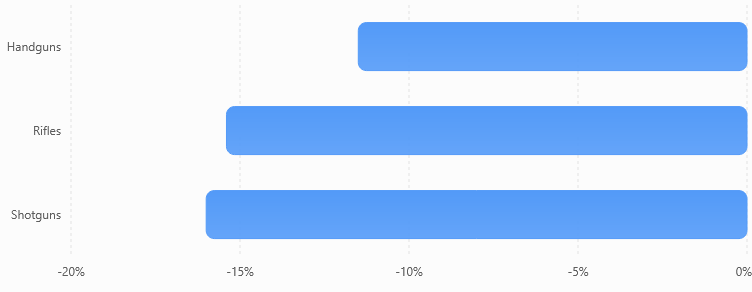
NSSF reported that 2025 new shotgun sales fell 16% and rifle sales fell 15.4%, substantially more than the 11.5% decline in handgun sales.
That doesn’t mean Midwest dealers should abandon long guns.
It means they should become more selective.
Instead of stocking deep quantities of every rifle and shotgun model available, consider building inventory around the firearms that match the hunting seasons in your immediate market.
A Midwest dealer might emphasize:
- Popular deer-hunting rifle calibers
- Versatile hunting shotguns
- Affordable entry-level hunting rifles
- Premium hunting rifles with higher margins
- Optics and mounts
- Slings, cases and other hunting accessories
- Ammunition for the specific firearms being sold
The key is to think of the firearm as the beginning of the transaction rather than the entire transaction.
The West: More Attention to State-Level Regulations
The West presents perhaps the greatest challenge to a simple regional inventory strategy.
California, Colorado, Oregon, Washington, Nevada and Arizona can have dramatically different regulatory environments and customer preferences. Consequently, a western dealer needs to think less about “Western inventory” and more about state-specific inventory.
A reasonable Q4 planning range is approximately -5% to flat compared with Q4 2025, but that number can vary substantially from state to state.
California and other regulated markets may require dealers to place greater emphasis on compliant configurations and products that can be sold legally in their particular jurisdiction.
Meanwhile, states such as Arizona and Idaho can present very different retail opportunities.
This makes inventory flexibility particularly valuable.
Dealers in the West should consider keeping fewer units of slower-moving specialty firearms on hand while maintaining access to them through distributor relationships. The objective is to preserve showroom variety without tying up excessive working capital.
The Northeast: Smaller Market, Higher Importance of Selection
The Northeast presents another distinct retail environment.
Massachusetts, Connecticut, New York, New Jersey and other states have regulatory requirements that can significantly affect what a dealer can sell and how a transaction is completed. Pennsylvania and New Hampshire provide a different market environment.
That means a regional forecast is particularly imperfect here.
For planning purposes, I would use a -6% to -1% Q4 unit range versus Q4 2025, with the understanding that individual states can deviate significantly.
The Northeast dealer should prioritize selection over sheer inventory depth.
Instead of carrying large quantities of every firearm, the better strategy may be to maintain a curated selection of compliant products at multiple price points.
That includes hunting firearms, commonly purchased handguns where legal, premium products and accessories.
What Dealers Should Actually Do With the Forecast
The most important part of a regional sales forecast isn’t the percentage.
It’s what you do with it.
The first mistake a dealer can make is treating a forecast as a reason to increase or decrease every category equally.
The better strategy is to divide inventory into three groups:
1. Traffic Drivers
These are firearms customers specifically come into the store looking for.
Keep these products visible and adequately stocked.
For many stores, this will include popular 9mm handguns, common hunting firearms and affordable rifles.
2. Margin Drivers
These are products that may sell in smaller quantities but generate more gross profit.
Premium handguns, higher-end rifles, optics, suppressors and specialty products can fit into this category.
Dealers don’t necessarily need huge quantities. They need the right products in front of the right customers.
3. Attachment Products
This may be the most overlooked category.
Every firearm purchase creates an opportunity to sell ammunition, magazines, optics, holsters, cases, cleaning equipment, lights and other accessories where legally applicable.
If firearm unit sales remain below the extraordinary levels of the early 2020s, increasing the average transaction value becomes increasingly important.
Watch Your Inventory Turns
NSSF’s RetailBI data shows that retailers reduced firearm inventory by 10.6% in 2025, while average selling price was essentially flat, increasing only 0.2%.
That is an important signal for 2026.
Dealers shouldn’t automatically respond to softer unit demand by loading up on inventory in hopes of creating sales.
Instead, monitor inventory turns by category and manufacturer.
If a $500 handgun sells twice as quickly as a $1,200 handgun, the higher-priced firearm may still be valuable—but it shouldn’t necessarily receive twice the inventory investment.
The goal is to maximize return on inventory dollars, not simply maximize the number of guns in the display cases.
Build a Q4 Inventory Dashboard
A smart dealer can turn the regional forecast into a simple weekly dashboard.
Track:
Units sold by category
Average selling price
Gross margin dollars
Inventory turns
Days of inventory on hand
Top-selling models
Ammunition sales per firearm sold
Accessory sales per firearm sold
Used versus new firearm sales
Then compare those numbers against the same period in 2025.
This gives the dealer something much more valuable than a national forecast: a forecast customized to his or her own customer base.
The Bottom Line
The firearm industry enters Q4 2026 in a much more normalized environment than the market experienced several years ago.
NSSF’s 2026 outlook calls for another year of declining new firearm unit sales, but current NICS indicators have shown several months of year-over-year improvement.
That suggests dealers shouldn’t approach the fourth quarter expecting another buying frenzy.
Instead, Q4 should be about precision.
Southern dealers may want broader depth in handguns, sporting rifles and NFA-related products. Midwest dealers should align inventory with hunting demand. Western dealers need to pay particularly close attention to state-specific compliance and product configurations. Northeastern dealers should emphasize curated selection and efficient inventory turns.
Most importantly, dealers should resist the temptation to treat national numbers as a substitute for their own store’s data.
The best forecast available to a gun dealer is a combination of national trends, regional conditions and the last 12 months of his own point-of-sale data.
In a softer market, knowing what to stock can be far more valuable than simply stocking more.