
Starting a new hobby, especially one in the realm of shooting sports, can be an expensive proposition. One of the more popular gun-related games in the last couple of decades has been Western Action Shooting (WAS). In this endeavor you need a proper costume and the guns to go with it. The two major organizations that govern this activity are the Single Action Shooting Society (SASS) and the Congress of Old West Shootists (NCOWS). With SASS, to get started you need two single action (SA) sixguns, a rifle (usually lever action) and a shotgun (mostly side-by-side doubles). For NCOWS you can also use these same guns, but there is a shooting category known as “Working Cowboy,” which only requires a sixgun and a rifle. NCOWS however, has more stringent requirements on their firearms, accoutrements, and costumes; with the emphasis on period correctness.
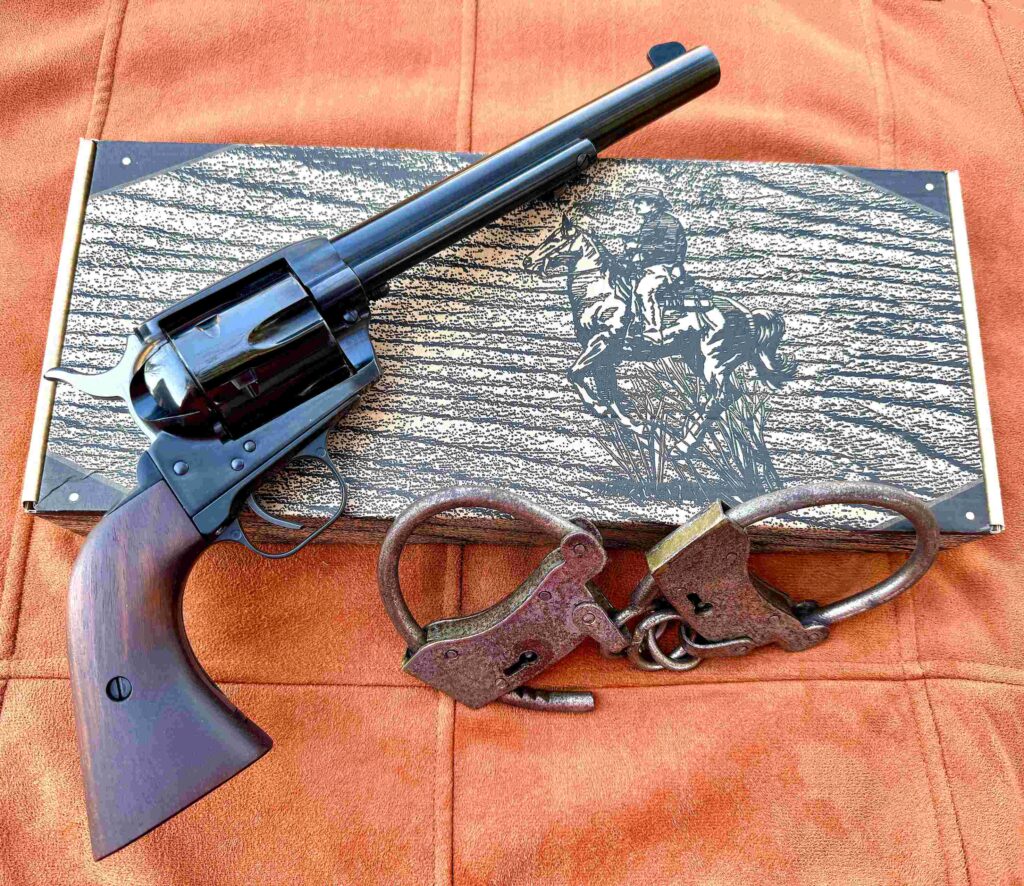
Take a proper six-shooter. Let’s go with the Colt Model 1873 Single Action Army. An actual Colt product is hard to get and will set you back $2,299.99 brand new. Then there are replicas imported by companies like Cimmaron Firearms, EMF or Taylor’s & Co. A basic SAA reproduction (NCOWS/SASS-legal) brand new, with wood grips, have MSRP’s running from $633.34 to $868.75. Of course you can shop the used market, but let the buyer beware. Most folks seem to gravitate towards new guns.
Enter the EAA Bounty Hunter
What if I told you that you can get a close copy of the SAA, new in the box, that has an MSRP of just $579.00! That’s right, it’s made by Weihrauch Revolver in Germany and imported by European American Armory (EAA). This gun is more like a Ruger Vaquero (MSRP $1,099.00) than a standard Colt SAA replica as it has features like a transfer bar in the action that allows all six chambers to be safely loaded, and an inertia-type firing pin mounted in the frame. Plus, the grip frame/trigger guard assembly, and ejector rod housing are made of anodized aluminum. On the unique side, the cylinder has recessed chambers that enclose the cartridge case head.
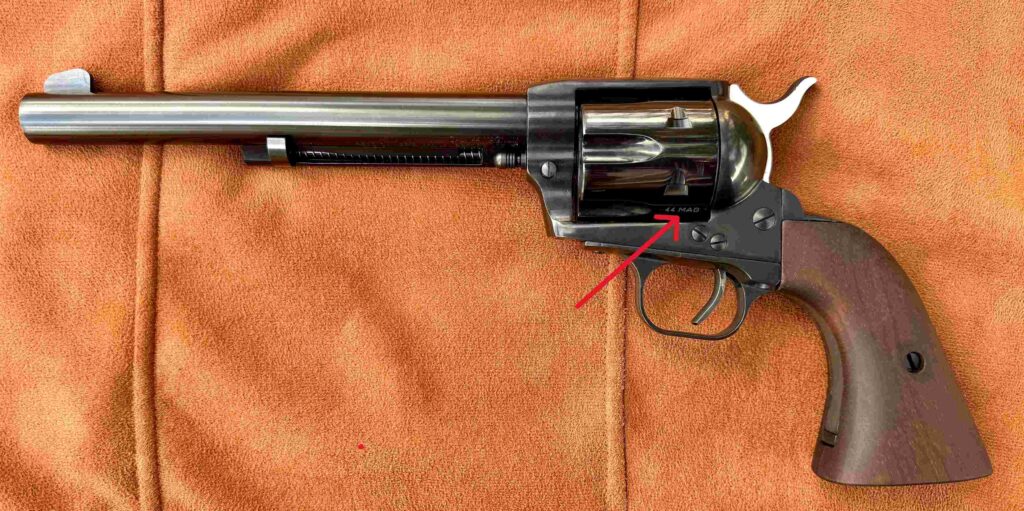
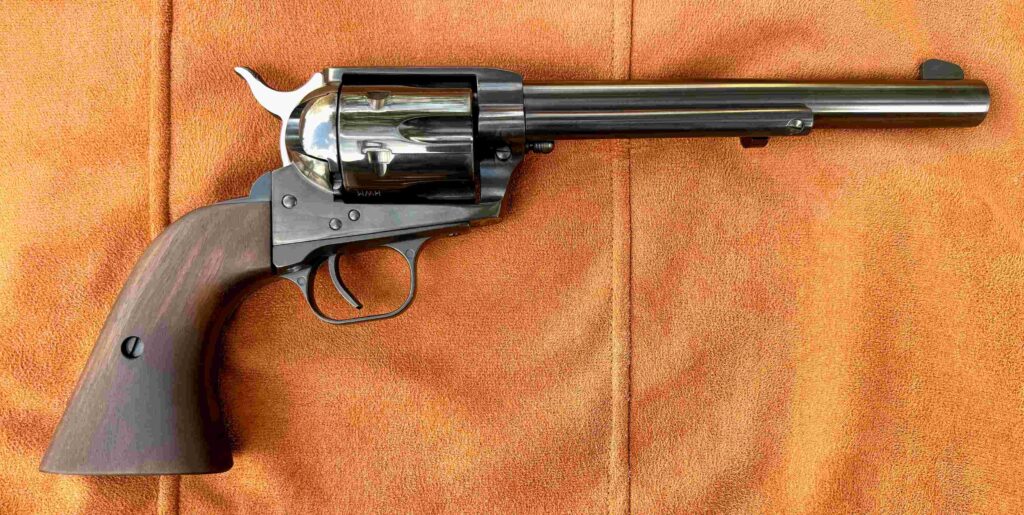
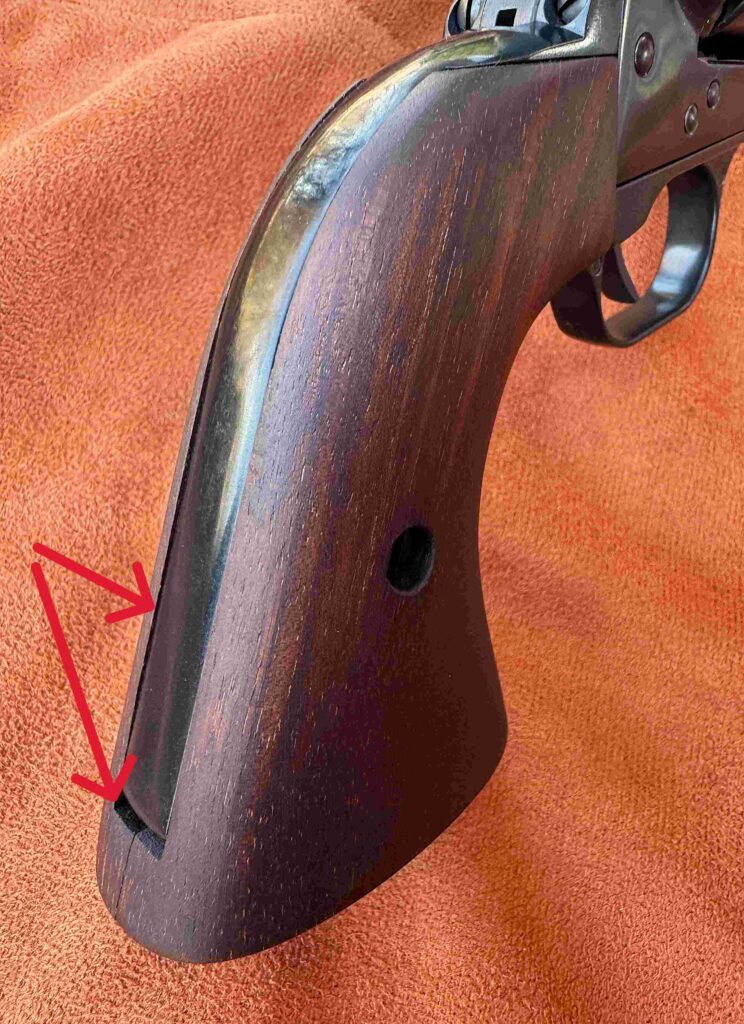
I decided to investigate this “hogleg” and requested a sample gun in .44 Magnum. I chose this caliber as I planned to use .44 Special and .44 Russian “Cowboy Loads,” which it readily accepts. The gun that was sent to me had an all-blue finish, a 7.5” barrel, and two-piece walnut grips. The outward appearance is most definitely SAA, but the wood on the butt of the grips extends down about 0.50” below the frame, giving it the dimensions of an 1860 Army percussion revolver. Unlike a Colt replica, when you cock the hammer, you don’t hear the traditional “4 clicks.” There is no 1st Click safety notch on the hammer, the first click is half-cock, this is where it needs to be to load/unload the revolver. The third click appears to set the transfer bar and then the last click puts you at “full-cock.” It does load like a Colt; with the hammer at half-cock, open the loading gate and insert cartridges in the chambers as you spin the cylinder clockwise manually. Clearing empty brass is much the same, but as you turn the cylinder, you push the empties out with the spring-loaded ejector rod attached to the right side of the barrel in a housing.
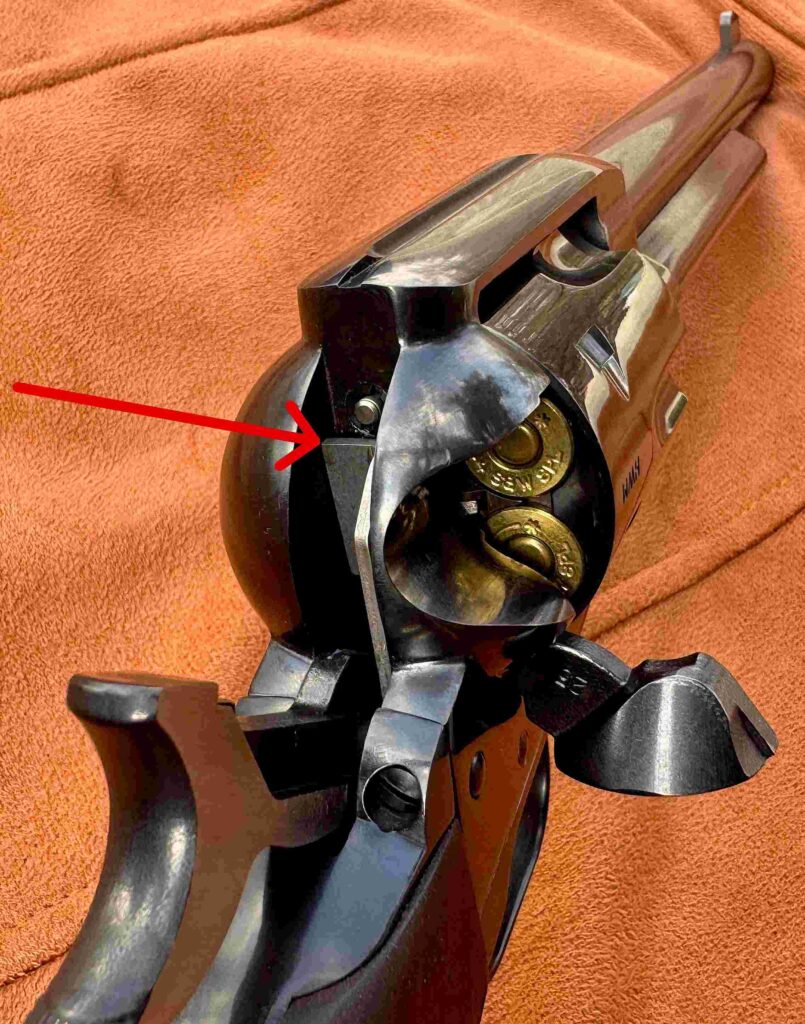
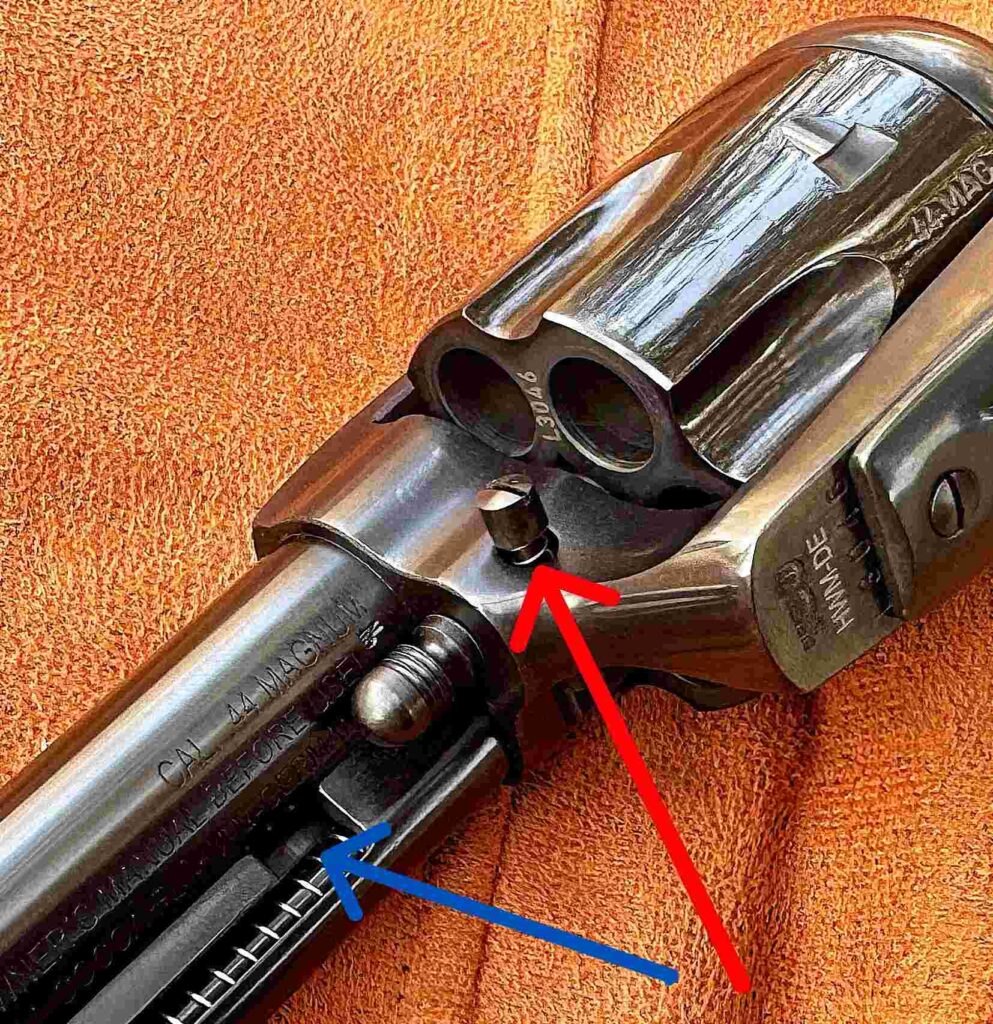
Other Colt-like features include the frame, which is of the post-1896 variety with the spring-loaded catch that retains the cylinder base pin. Also, the sights; a blade front and fixed notch rear sight. I will say though that these sights on the Bounty Hunter are an improvement over the originals. The front sight is 1/10-inch in width and squared, while the rear notch is also square and offers an enhanced sight picture. A divergence from the original SAA is the trigger. For whatever reason, it angles more forward than the original. This angle, combined with the average pull weight of 6.6 lbs. caused some discomfort to the end of my trigger finger after shooting 100 rounds. I’ll also mention the hammer; it certainly drops with aplomb, and should set off even the most recalcitrant primer. Metal to metal fit was top shelf, as was the overall finish, but wood to metal fit was a little off.
The Proof is in the Pudding
I mentioned earlier, I didn’t plan to use .44 Magnum ammunition in this T&E, but decided to stick with .44 Special and .44 Russian “cowboy cartridges” that I had on hand. Alphabetically, from Black Hills I had their .44 Special load with a 210 flat-point lead (FPL) bullet. Fiocchi had previously sent me some of their .44 Russian cartridges that have a 247 gr. round-nose lead bullet (RNL), so I decided to include them. I also chose some HSM .44 Special Cowboy Cartridges with a 200 gr. round-nose, flat-point (RNFP). My ammo locker also yielded some vintage 10-X CAS cartridges in .44 Special, with a 200 gr. RNFP bullet. Lastly, I had in stock some Winchester .44 Special Cowboy Action Loads, with a 240 gr. lead flat-nose (LFN) bullet.
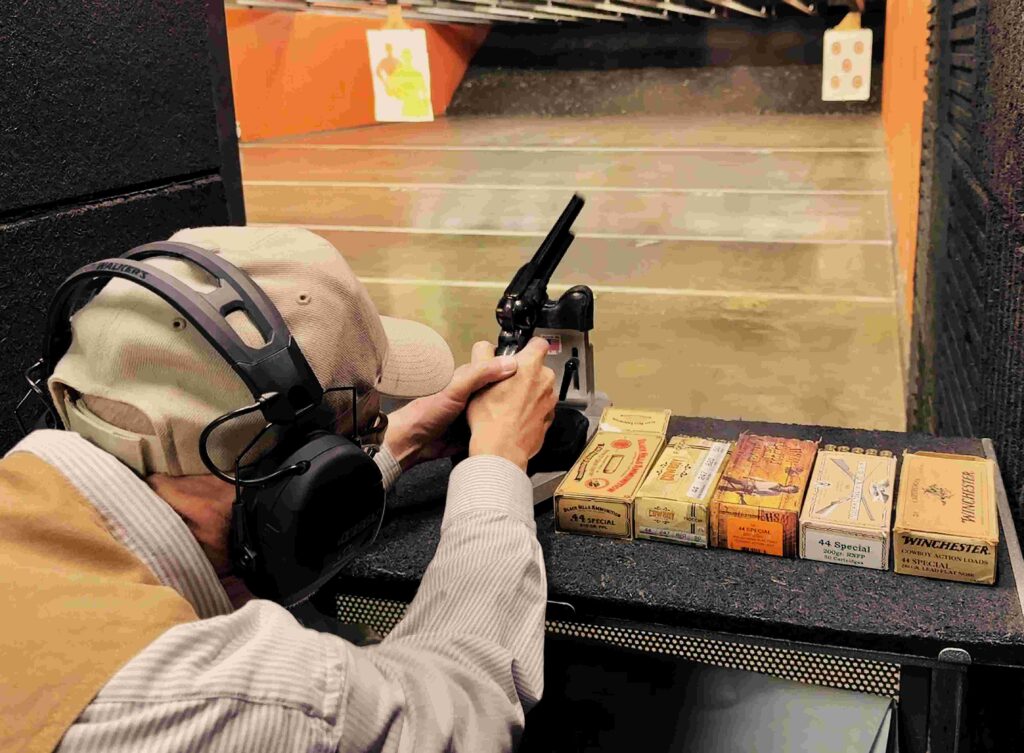
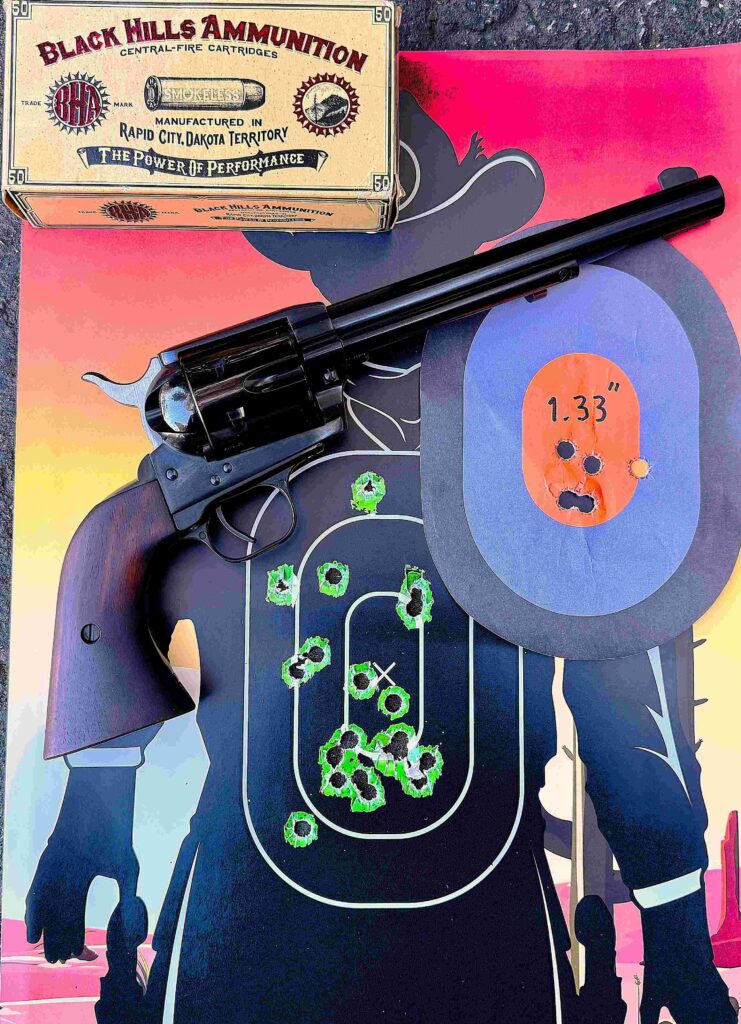
This time of year, it’s hard to find a cowboy shoot, so all my test-shooting of the EAA Bounty Hunter was at an indoor range. My first task was to get velocity measurements of my ammunition, shot from the 7.5” barrel of the Bounty Hunter. At the same time, I sent a bullseye target down range to the 10-yard line to see how well the sights were regulated. I got my velocity figures (see the performance chart) and was pleased to see the sights point of aim, point of impact (POA-POI) were pert-near right on. Next, I set up my Ransom Steady Rest and sent a multi-bullseye target 15 yards down range to do an accuracy potential evaluation. Three 5-shot groups were fired with each test load. My first 5-shot group from the bench with the Black Hills cartridges yielded a 4-shot, sub one-inch group, which was ruined by a flyer. Black Hills still came out on top with a 1.33” 5-shot cluster. Kudos also goes to the Fiocchi .44 Russian load with a 1.39” group. The largest group average was 2.37” and the rest were under 2.35.” Again, POA-POI was very good.
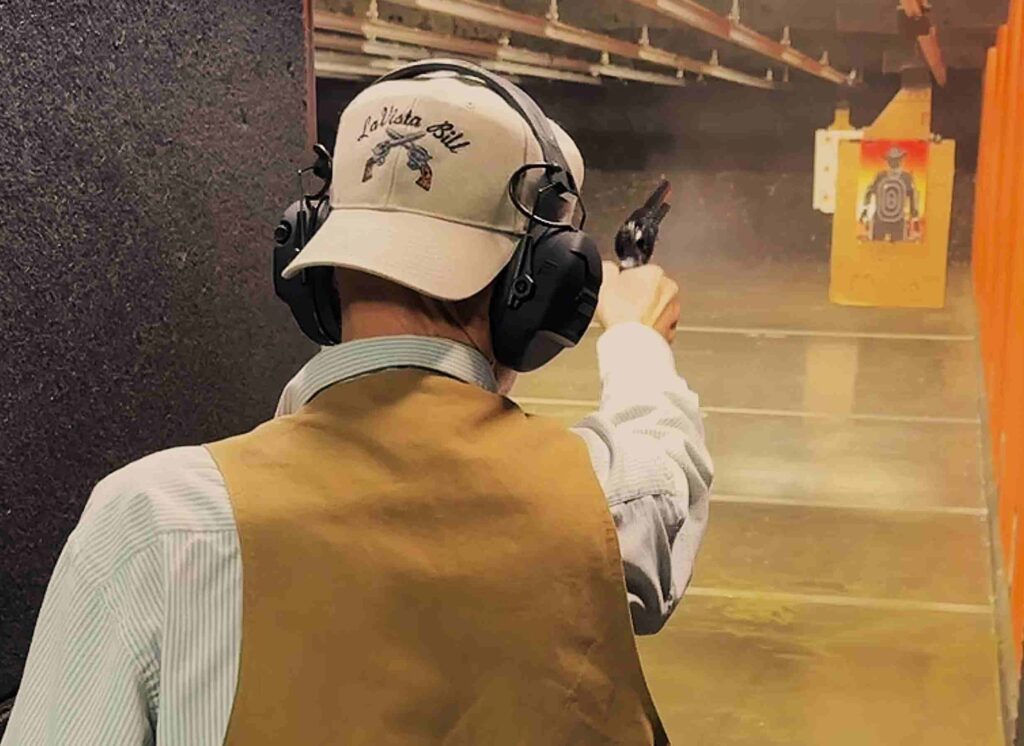
To do some off-hand, cowboy-type shooting, I sent a “Gun Slinger” target down to the 10-yard line, and loaded the Bounty Hunter with a mix of the test ammo. Using a strong-hand-only “Duelist” stance, I proceeded to ventilate the target, shooting as fast as I could press the trigger, cock the hammer, get a flash sight picture, and trigger-off the next shot. I did this four times, for a total of 20 shots. I was surprised that all 20 bullet impacts stayed within the scoring ring area of the target.
I’ll have to say that I was pretty impressed with the EAA Bounty Hunter. I do wish they’d straighten out that trigger, as my finger was pretty sore after the T&E was concluded. Another small annoyance was a notch cut into the bottom of the ejector rod housing. This allows you to lock back the ejector rod. Why, I don’t know? If the empty brass didn’t just side out of the chambers when I was reloading, I’d use the ejector rod, and all too often it would catch in this slot. One other note for WAS competitors. At the loading table before you shoot a stage, the cowpoke manning the loading table is there to see that the chamber under the hammer of your sixgun is empty. Those recessed chambers make this a bit difficult, but not impossible. I think for the price-point and the overall performance of the Bounty Hunter, you will certainly get your money’s worth, and makes it a little easier for a newbie to get in on the action. For more information, go to www.eaacorp.com.
EAA Bounty Hunter Specifications
MECHANISM: Single action revolver
CALIBER: .44 Magnum (accepts .44 Special/Russian)
CAPACITY: 6 cartridges
BARREL: 7.5”
OA LENGTH: 12.7”
EMPTY WEIGHT: 41.6 oz.
SIGHTS: Fixed notch rear, blade front
FINISH: Polished blue steel, frame anodized aluminum
STOCKS: Two-piece walnut
MSRP: $579.00
EAA Bounty Hunter Performance
|
Cartridge |
Ave. Velocity |
Best Group |
Average Group |
|
Black Hills .44 Spl. 210 gr. FPL |
760 FPS |
1.33” |
1.69” |
|
Fiocchi .44 Russian 247 gr. RNL |
724 FPS |
1.39” |
1.74” |
|
HSM .44 Spl. 200 gr. RNFP |
799 FPS |
2.19” |
2.34” |
|
Ten-X .44 Spl. 200 gr. RNFP |
615 FPS |
2.16” |
2.37” |
|
Winchester .44 Spl. 240 gr. LFN |
746 FPS |
1.02” |
1.52” |
NOTE: Bullet weight measured in grains, velocity in feet per second 15 inches from the muzzle by a Garmin Xero C1 Pro chronograph, and accuracy in inches for three 5-shot groups at 15 yards.
For dealer orders visit www.davidsonsinc.com
For consumer purchases visit www.galleryofguns.com